
In experiential design, “interactive” and “immersive” are frequently used as interchangeable design approaches. These two terms are often grouped as if they represent the same ambition: engagement.
They do not.
While both approaches aim to deepen visitor connection, they operate through fundamentally different mechanisms. Understanding that distinction shapes spatial planning, budget allocation, content development, technology integration, and ultimately, the kind of impact a space creates.
Let’s understand how each approach shapes experience differently.
What Does Interactive Mean?
An interactive space responds to the visitor. It invites participation. The defining characteristic of an interactive space is the two-way exchange between the visitor and the environment. There’s an action and a reaction.
Below are the common examples of interactive elements used in the design of spaces such as museums, visitor centres, parks, urban places, and heritage sites:
- Digital Touchscreens
- Digital kiosks
- Audio stations with selectable stories
- Hands-on science installations
- Interactive maps
- Quiz-based learning walls
- Gesture-controlled media projections
Interactive design–based spaces are particularly effective for simplifying complex information, sparking curiosity, enabling personalised exploration, fostering family engagement, supporting gamified learning, delivering data-driven storytelling, and presenting layered content in accessible ways.
Case Study – The Children’s Arabic Language Edutainment Centre
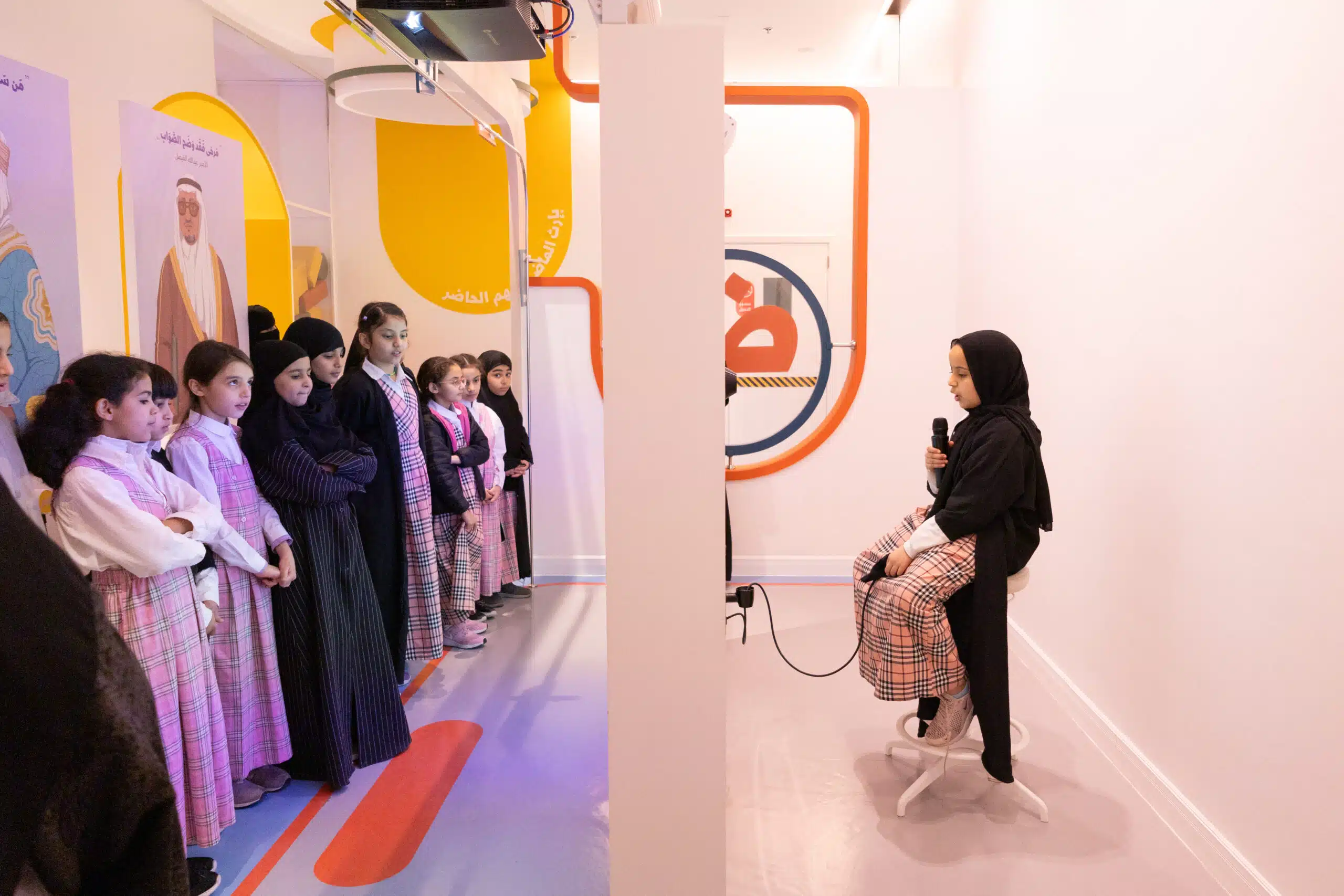
The challenge was to design an exhibition that makes Arabic, one of the world’s most complex languages, easily understandable and engaging for children.
formula D_ responded by designing a fully interactive learning environment incorporating augmented reality (AR), projection mapping, gesture tracking, sensor-triggered LEDs, animated storytelling, gamified learning mechanics, and physical–digital hybrid installations.
Each exhibit encourages active participation through face-tracking performances, movement-based vocabulary games, gesture-controlled phonetic challenges, physical–digital interactions that demonstrate root-word evolution, and a 3D projected map with tablet integration exploring the global influence of Arabic.
Here, interaction drives learning. Children trigger outcomes, receive feedback, and shape their own educational journey.
What Makes a Space Immersive?
A space becomes immersive when the visitor stops being an observer and feels as if they are actually experiencing something. It surrounds the visitors with a carefully crafted environment through light, sound, scale, texture, and spatial design. Immersive experience designs interact with isolated elements; they step into a cohesive world where every detail supports the narrative.
Common Elements Used to Design Immersive Experience:
- Projection-mapped architectural surfaces
- Atmospheric lighting design
- Spatial audio systems and immersive soundscapes
- Multi-sensory environmental effects (scent, mist, atmospheric layers)
- Reconstructed historical environments
- Scenographic themed spaces
- 360° video environments and dome theatres
- Dark ride experiences
- Monumental immersive installations
- Narrative-led spatial journeys
Case Study – River of Grass
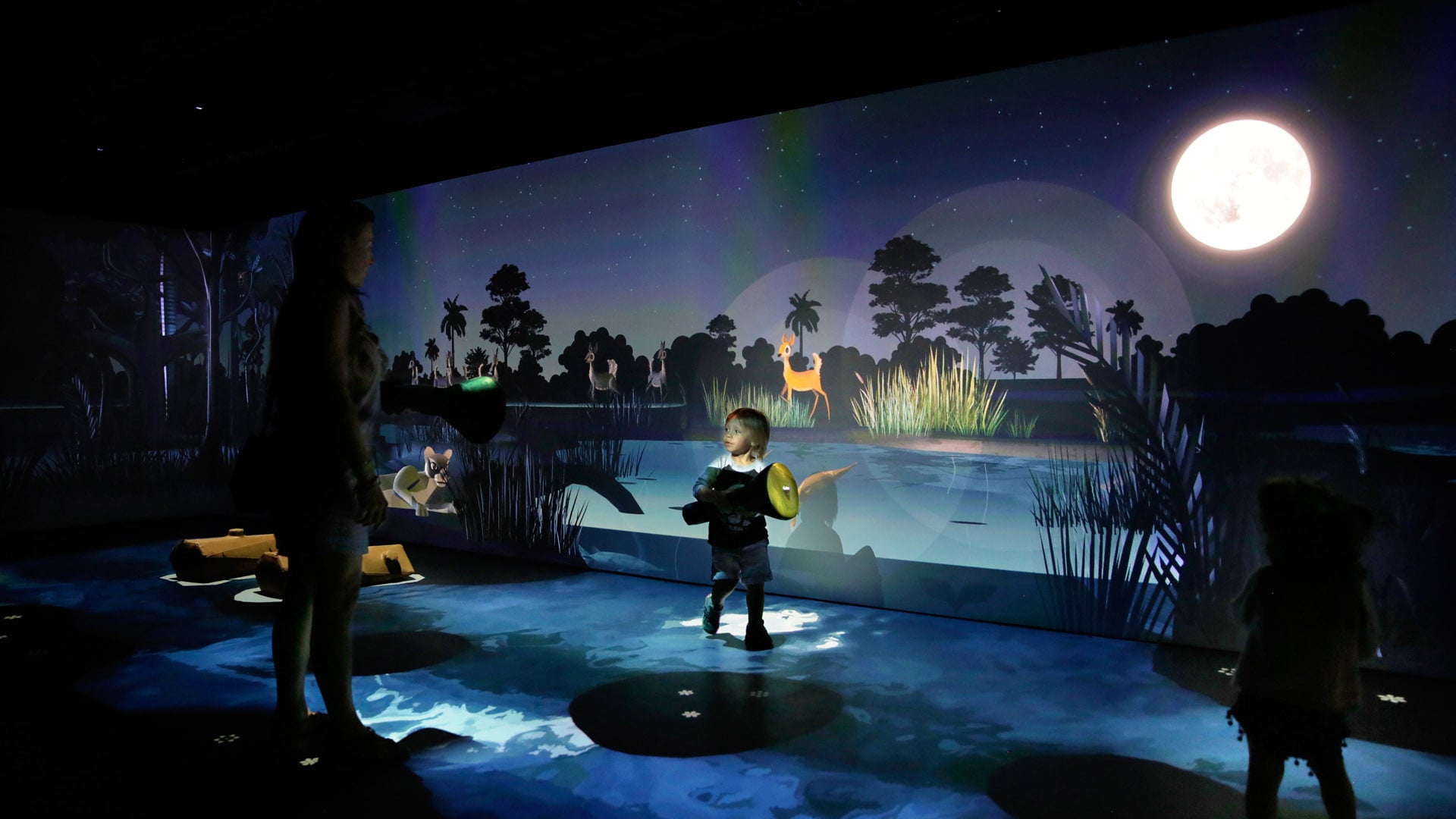 At the Patricia and Philip Frost Museum of Science, formula D_ developed River of Grass to teach children about the Everglades ecosystem through immersive exhibition design.
The installation integrates large-scale wall & floor projections, motion-tracking systems, physical props, and a custom-built 3D virtual environment to create a seamless, responsive landscape. Using 16 projectors and seven networked motion detectors, the space is transformed into a dynamic Everglades habitat that evolves throughout the day.
Visitors experience shifting lighting conditions from dawn to dusk, seasonal transitions, and changing weather patterns.
Physical log props allow children to dam virtual water beneath their feet, directly influencing downstream plant and animal life. Torch props reveal nocturnal species otherwise hidden in darkness. These cause-and-effect interactions teach water flow, ecosystem balance, and environmental dynamics in an intuitive, spatial way.
Check out our work in experiential design!
Interactive vs. Immersive: Understanding the Strategic Design Difference
The core difference between them is that interactive designs enhance participation, while immersive designs involve presence. Let’s explore the table below for more clarity:
| Aspect | Interactive Spaces | Immersive Spaces |
| Core Principle | Participation and response | Presence and environmental engagement |
| Visitor Role | Active decision-maker | Embedded experiencer |
| Engagement Mechanism | Action triggers reaction | Context shapes perception |
| Narrative Structure | Modular, self-directed, often non-linear | Choreographed, sequential, spatially guided |
| Design Priority | Interface clarity, responsiveness, accessibility | Spatial continuity, atmosphere, sensory cohesion |
| Cognitive vs Emotional Entry | Exploration and inquiry | Mood and emotional alignment |
| Information Delivery | Layered, user-controlled depth | Integrated into the environment and narrative |
| Measurement Indicators | Interaction rates, dwell time, usage analytics | Emotional resonance, memory retention, qualitative feedback |
| Ideal Application | Simplifying complex concepts, integrating gamification, and enabling personalised exploration | Narrative-led environments, emotional connection, and lasting impact |
Related Articles:
Benefits of Human-Centered Experiential Design in Urban Developments
How Interactive Exhibition Design in Museums Engages Gen Z?
6 Experiential Design Trends Transforming Museums in 2026
Can Both Interactive and Immersive Experience Designs Be Combined?
Yes, and in many of the most effective experiential spaces, they are. The two approaches are not in competition; they serve different moments within the same visitor journey. When both interactive and immersive designs are planned together from the start, rather than one being layered onto the other as an afterthought, the result is a space that feels both cohesive and alive.
At formula D_, we integrate both interactive and immersive elements into our experiential design projects, creating museum exhibits, heritage environments, parks, science centres, conservation spaces, and urban developments that balance participation with presence.
Contact us today to create visitor experiences that truly transform your spaces.
FAQs
Q 1. Which approach is more suitable for children and adult audiences?
Both interactive and immersive experiences are effective across age groups. Younger audiences often respond strongly to physical interaction and responsive environments, while adult audiences may engage more deeply with immersive narrative settings. The key lies in aligning the balance of interactive and immersive strategies with the behavioural patterns and cognitive expectations of the target demographic.
Q 2. Which technologies are used to create immersive experiences?
Immersive experiences typically use technologies such as projection mapping, LED media surfaces, spatial audio systems, motion tracking, AR/VR, real-time 3D engines, interactive sensors, and atmospheric lighting.
Q 3. Can Interactive experiences benefit learning outcomes?
Yes. Interactive experiences can improve learning outcomes by encouraging active participation, reinforcing information through feedback, and allowing visitors to explore concepts at their own pace. By involving movement, decision-making, and problem-solving, interactive design helps simplify complex ideas and supports better understanding and retention.