
Walk into any museum or visitor center today, and you will likely see people from different countries, speaking different languages, standing in front of the same exhibit.
Have you ever wondered how these spaces create experiences that work for visitors who may not speak the same language? This is where an Experiential Design Agency plays an important role.
Let’s get to know how these agencies design environments where information, stories, and interactions can be accessed in multiple languages without interrupting the visitor journey.
Why Visitor Centers Create Multilingual Experiences?
In many regions, a significant portion of the population speaks a language other than the primary national language at home. Because of this, relying on a single language can limit how visitors understand and engage with exhibits.
Research shared by the American Alliance of Museums highlights this trend. Around 20% of the population in the United States speaks a language other than English at home. In some major cities, the proportion is even higher, including Chicago (36%), New York City (49%), and Los Angeles (59%).
These patterns show that tourist or visitor centers cannot assume that all audiences will be comfortable accessing information in only one language. Providing multilingual content helps ensure that exhibitions remain accessible and understandable for a broader range of visitors.
Key Approaches Experiential Design Agencies Use to Create Multilingual Experiences
Creating multilingual experiences requires careful planning. Experiential design agencies focus on understanding visitor language needs, planning how content will be delivered, designing flexible content layouts, using technology for language selection, ensuring cultural accuracy, and testing the experience with different users. Let’s explore in detail:
1. Understanding Audience Diversity
Experiential designers conduct research to identify who the visitors are and what languages they are most likely to speak.
This includes studying visitor demographics, geographic reach, and expected international participation. For example, an international museum or a global brand exhibition may need to support several major languages, while a regional cultural space may focus on two or three.
Understanding the audience helps designers decide how many languages to support, when translation is necessary, and how to structure content for clarity.
2. Integrating Language Strategy in Experience Planning
Multilingual design works best when it is integrated into the experience framework from the beginning rather than added later.
During the early stages of Interactive Experience Design planning, agencies map out the entire visitor journey. At each stage of the experience, they determine how information will be delivered and how visitors will select their preferred language.
This planning includes identifying key visitor touchpoints, such as:
- Entry orientation areas, where visitors first receive information about the experience and select their preferred language.
- Interpretive exhibit panels that introduce the story, context, or theme of a section.
- Interactive stations where visitors engage with digital or physical activities.
- Guided storytelling moments such as projection shows or immersive media presentations.
- Exploration zones where visitors move through thematic sections of the exhibition.
- Exit or reflection areas where visitors review key takeaways or access additional information.
Note: At formula D_, we build immersive environments where every visitor feels the space was made for them. Our process begins with experience master planning, a holistic blueprint that maps out how a visitor will move through, feel, and connect with a space before a single element is designed. From there, we layer in technology, projection mapping, AR, sensors, gamification, and responsive audio, not as add-ons, but as native parts of the environment.
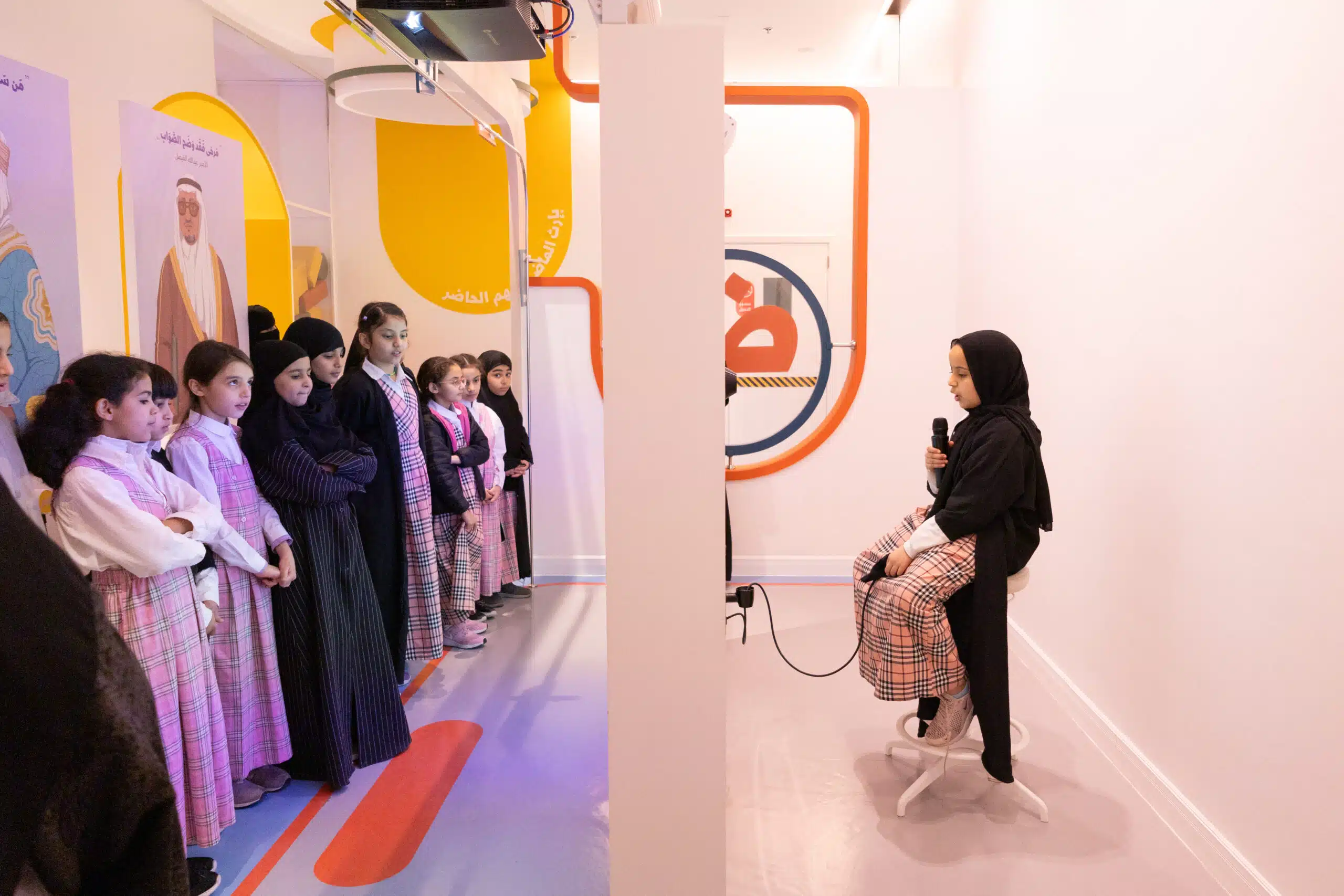
Sometimes, the most powerful way to make a language accessible is to turn it into something you can touch, play with, and inhabit. That was the challenge formula D_ took on when partnering with the King Salman Global Academy for Arabic Language (KSGAAL) to create the Children’s Arabic Language Edutainment Centre in Saudi Arabia, designing a series of fully interactive exhibits that turned Arabic language learning into something joyful and instinctive.
3. Designing Clear and Adaptable Content
One of the biggest challenges in creating multilingual experiences is content expansion. Translated text often takes up more space than the original language. If this is not considered during the design stage, layouts can become crowded and difficult to read.
To address this, experiential designers create flexible content systems that allow information to adapt across languages without affecting readability. Text panels, digital displays, and interactive interfaces are structured with adaptable layouts that can accommodate variations in text length.
4. Using Technology for Seamless Language Switching
Instead of relying on multiple physical panels for each language, interactive technology allows content to be delivered dynamically based on visitor preferences.
Digital interfaces are used to let visitors select their preferred language at the beginning of an interaction. Once selected, the system displays the same information, visuals, or narration in the chosen language without changing the overall exhibit structure.
Common technologies used to support this include:
- Touchscreen interfaces with language selection menus
- QR codes or RFID systems that allow visitors to access translated content on their smartphones.
- Audio guides offering multiple language tracks
- Augmented reality overlays that present translated information within the exhibit environment
- Projection-based systems that dynamically adapt visual content for different audiences
5. Designing Intuitive Language Selection
Exhibits must make language selection simple and intuitive. If visitors struggle to find or switch languages, it disrupts the interaction.
Experiential design agencies address this by using universally recognizable icons, flags, or clearly labeled language buttons. The interface is designed so that visitors can quickly identify their language before engaging with the content.
6. Ensuring Cultural Context and Accuracy
Translation alone does not guarantee a meaningful experience. Cultural context also matters.
Designers work with translators and cultural consultants to ensure that the translated content reflects local context, tone, and sensitivity. Certain terms, references, or storytelling styles may need to be adapted rather than directly translated.
This approach ensures that the message remains clear and culturally appropriate for different audiences.
7. Testing with Multilingual Users
Before launching an experience, designers conduct usability testing with users who speak different languages. This step helps identify issues related to translation clarity, navigation, readability, or interface usability.
Testing ensures that visitors can easily navigate the experience, understand the information, and interact with the exhibits without confusion.
8. Supporting Accessibility and Inclusivity
Experiential design agencies often integrate multilingual interpretation with accessibility features such as:
- Audio narration for visually impaired visitors
- Captioned videos to support visitors with hearing impairments
- Simplified language versions for broader understanding
- Mobile access to translated content
These additions make experiences more inclusive while improving overall visitor engagement.
9. Continuous Content Updates and Scalability
In many exhibitions, content may need to be updated when new information is added or when exhibits are modified. When multiple languages are involved, these updates also require changes in translated text, audio, or digital content.
To manage this efficiently, designers structure content systems so that updates can be made across different languages without redesigning the entire exhibit.
Such systems are useful for museums, cultural spaces, and brand environments where content may need periodic revisions.
Related Articles:
The Difference Between Interactive and Immersive Spaces
How Interactive Exhibition Design in Museums Engages Gen Z?
Mistakes to Avoid in Children’s Museum Exhibit Design
Whether you’re building a museum, a brand space, or a cultural centre, formula D_ would love to hear about your vision. Let’s create something unforgettable together.